
A Godot 3D (mini) game where teams of players have to avoid falling objects for a certain amount of time. Inspired by an old Counter-Strike: Source MiniGames map. Uses TMC's Dot assets and servers are deployed onto the gaming platform!
This is a game to demonstrate the capabilities of the Dot collection built on-top of Godot 4 and TMC's gaming platform. In this 3D game, players spawn on top of platforms balanced on single pillars while a cannon in the middle shoots props up into the air that may knock them off. Players must survive in teams or individually to win (depending on server setup). This is heavily inspired off of a classic Counter-Strike: Source MiniGames map called mg_3k_smash_lego_copter (gameplay video).
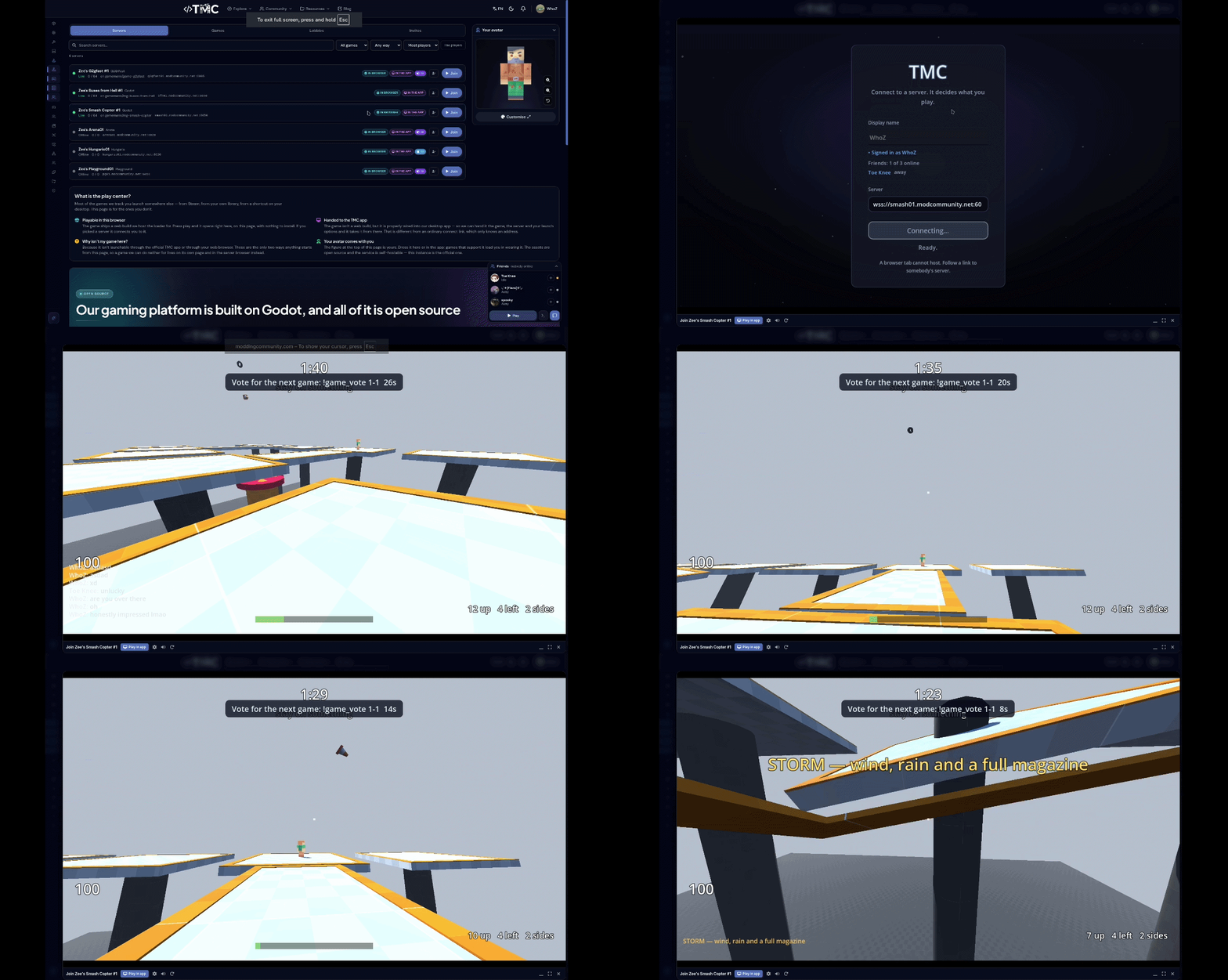
Play on my test server here!
This project and the assets under it are COMPLETELY OPEN SOURCE. You are free to use, modify, and distribute them under the terms of the MIT license. The only thing not open source is the back-end web infrastructure. So if you opt into using your own authentication backend instead of integrating with TMC, you will need to build and integrate your own back-end infrastructure.
From Maintainer & WARNING
This project, along with every asset it is built on, was built initially with Claude Code and will continue to be maintained and extended using it. This is because I (gamemann) cannot build the entire TMC platform alone (I wish I could lol).
Please treat this as partially tested. It has its own headless test suite and that suite passes, but very little of this has been in front of real players yet. Expect rough edges, and please report anything you run into.
I intend on reviewing code, testing, and editing documentation regularly. If you're interested in helping out, please let me know!
How it plays
A round has two halves.
The first two minutes are about keeping your footing. Two to six teams stand on platforms balanced on single pillars, forty metres up. Nobody can hurt anybody. A platform leans toward whoever is standing on it, and past sixteen degrees it comes off its pillar and takes everybody on it down to the floor. Meanwhile a cannon in the middle aims at the platforms that are still up and throws props at them, getting heavier as the round goes on:
| Tier | Props | What it does to a platform |
|---|---|---|
| 1 | Crate, tyre, cone | Wobbles it |
| 2 | Barrel, boulder | Tips it. A barrel also explodes |
| 3 | Container, slab | Knocks a corner off it |
| 4 | Monolith | Destroys it, with everybody on it |
Shift is a brake, not a sprint. Running is the default speed, and running is what tips a platform. A running player leans it about three times as far as a standing one, so the way to cross a platform somebody else is standing on is to slow down.
The last ninety seconds are a fight. Everybody still standing is teleported to a corner pad in the sky with random weapons from zee-dot-weapons. Catwalks join the corners to a ring in the middle. The last team standing wins.
A third of rounds are special rounds, which change the rules for a while: barrage, heavy, feather (low gravity), slick (ice), gale (wind), quake, jelly (loose pillars), downpour and rush. Two can overlap.
The field is re-rolled every round from eleven layouts, from the full grid down to two islands: full, checker, islands, spine, airfield, gauntlet, broadside, hollow, and three bigger ones with more than one flat level, terraces (stepped ramps), ring (a ring of decks round the tube, with corner towers) and watchtowers (two towers joined by bridges). Every piece is a platform, a bridge or a tower and falls the way platforms do. You can stand on the chopper and be carried by it. The layouts are listed and voted through dot-map like the other games (M). Two of them park a chopper: the pilot flies it with the movement keys and drops crates on whatever is underneath, and the passenger can shoot.
When you fall, you are out until the next round and watch somebody on your own side who is still up.
Controls
| Key | Action |
|---|---|
| WASD | Move. In the chopper: W/S tilt forward and back, A/D turn |
| Shift | Walk (the brake) |
| Space / Ctrl | Jump / crouch. In the chopper: up / down |
| E | Get into or out of the chopper |
| Mouse 1 | Fire (in the showdown). In the chopper: drop a crate |
| 1-5 | Weapon slots (in the showdown) |
| F5 | First or third person |
| Y / U | Chat / chat to your side |
| V | Push to talk |
| H | Help: the rules and every key as you have it bound |
| Esc | Menu: settings (every key above can be rebound), help, and leave |
While you are out: Mouse 1 / Mouse 2 watch the next or previous player, and F5 switches between their eyes and behind them (if the server allows it).
Getting started
You need Godot 4.7. The game is built from many Dot addons, each in its own repository, so the easiest way to get everything is dot-bootstrap. It clones every project and links the addons into each one:
git clone https://github.com/modcommunity/dot-bootstrap.git
cd dot-bootstrap
./bootstrap.sh
cd projects/mg-smash-copter
./game.sh
On Windows, run bootstrap.ps1 instead and open the project in Godot.
game.sh does everything else:
| Command | What it does |
|---|---|
./game.sh |
Play offline against bots |
./game.sh online |
Start a local server and the browser client, and print the link to open |
./game.sh online down |
Stop them |
./game.sh server |
Start a local dedicated server only |
./game.sh test |
Check every script and run every test suite |
./game.sh shot |
Save a screenshot to screenshots/. ./game.sh shot --help lists the views |
./game.sh help |
All of the options |
online and server use dot-server-deploy, which bootstrap clones next to this one. Run its ./setup.sh once first.
Running a server
Settings are cvars (or environment variables like SC_LAYOUT_IDS). Set them in the server's config, on the command line, or live from the console. Most of them take effect straight away.
sc_survival_seconds 120     // length of the first half
sc_showdown_seconds 90      // length of the fight
sc_teams 2                  // number of sides (up to six)
sc_stiffness 7.0            // lower is wobblier
sc_motion_gain 2.0          // how much more a running player tips a platform than a walking one
sc_cannon_interval 1.9      // seconds between shots
sc_cannon_max_tier 4        // 2 = nothing that destroys a platform outright
sc_special_chance 34        // percent of rounds that are special
sc_chopper 1                // 0 = no chopper on any layout
mp_teammate_passthrough 1   // shots and team-mates: 0 a team-mate is hit and blocks, 1 through one at the muzzle, 2 through every team-mate
bot_quota 4                 // players a round is kept at with bots; each person who joins replaces one
bot_quota_mode fill         // fill (as above), fixed (that many bots), per_player (that many per person) or off
sc_bots 1                   // 0 = no automatic bots at all
bot_difficulty medium       // easy, medium, hard or nightmare: how bots turn, aim and react (every bot_* setting)
sc_bot_advance 200          // how far a bot walks toward a fight in the showdown, metres
sc_bot_lean_notice 1.15     // degrees of lean a bot feels before it walks uphill (higher is clumsier)
sc_bot_spray 0.6            // metres of miss a bot accepts when it fires (higher sprays from further)
sc_spectate_camera 1        // 0 = anybody may watch anybody, 1 = own side only, 2 = nobody
The bot count cvars are the family's shared ones (dot-server's DotBotQuota), and so are bot_difficulty and every bot_* setting (dot-bot; bot_settings lists them). sc_min_players still works and sets bot_quota, and sc_bot_spread sets bot_aim_error; both are deprecated. Solo, the same names are at the console, and ./game.sh -- --bot_difficulty hard sets the preset at launch.
Dead players fall as ragdolls (dot-player-char); the server picks how each one goes down and everybody sees the same fall. sv_ragdoll 0 makes it a quick fall with no physics, sv_ragdoll_style picks ragdoll, stiff, topple or hide, sv_ragdoll_time and sv_ragdoll_max say how long and how many, and sv_ragdoll_reactions weights the falls (limp, face_plant, crumple, headshot_launch, power_launch; 0 turns one off).
mp_teammate_passthrough is the family's shared one from dot-combat, live from the next shot. At 2 a team-mate in the line never stops a shot; splash still reaches them.
--sc-layout-ids=checker (or SC_LAYOUT_IDS=checker) plays one layout all evening. An empty server fills itself with bots, because a round needs two sides.
Console commands: sc_status, sc_net, sc_layouts and sc_specials.
Admin commands
These come from dot-moderation: noclip, freeze, speed, gravity, god, buddha, hp, slay, slap, rename and the teleports. blind <player> [on|off|seconds] blacks out that player's screen, and beacon <player> [on|off] puts a ring and a ping on them for everybody. respawn, give and strip are turned off, and modtools says why.
Stats and achievements
The server counts rounds survived, showdowns won, people knocked out in the corners, falls, platforms you tipped, and props that landed on your platform and missed you. Achievements are built on those. They are kept in memory unless the server sets SC_PROGRESS_DIRECTORY, and only reported to the website with SC_REPORT_PROGRESS and a credential.
Testing
./game.sh test                  # every script parses, then every suite runs
./game.sh test headless_run     # one suite
| Suite | What it covers |
|---|---|
headless_run |
The game itself: platforms, the cannon, layouts, special rounds, the showdown and bots |
headless_net |
A server and a client in one process, over the network code |
dedicated |
A real server: boots, loads the game, runs its commands |
CLAUDE.md has the design decisions and the reasoning behind them.
Not done yet
- Other players' guns aren't drawn in their hands yet (yours is).
- There is no settings menu, so volume, mouse sensitivity and field of view can't be changed yet.
- The sounds are generated stand-ins. Dropping a file such as
audio/cannon_fire.oggin replaces one.
Credits
The surfaces are Kenney's Prototype Textures, and everything the cannon throws is from Kenney's Survival and Car kits (kenney.nl, CC0). The beach balls on the platforms are dot-props' toys, drawn in code, with Kenney's sounds (CC0) credited in addons/dot_props/toys/sounds/CREDITS.md. The players are the family's animated people from Quaternius' Zombie Apocalypse Kit (CC0 1.0, credited in dot-player-char). The weapons are from zee-dot-weapons. Footsteps are Kenney's Impact Sounds and the ambience beds are generated by dot-audio, both CC0 and shipped in dot-audio (addons/dot_audio/stock/CREDITS.md). Each kit's licence is next to its files. The towers' railings are Kenney's Survival Kit fence (CC0). The chopper is plain geometry, because none of the kits has a helicopter.
License
MIT. See LICENSE. The Kenney art is CC0, which is public domain.
互动趋势
Game - Smash Copter 是一个 Smash Copter 资源。它拥有 2 次下载、16 次浏览和 0 次收藏。 此条目属于 4 个标签。
评论 (0)
登录后即可评论。